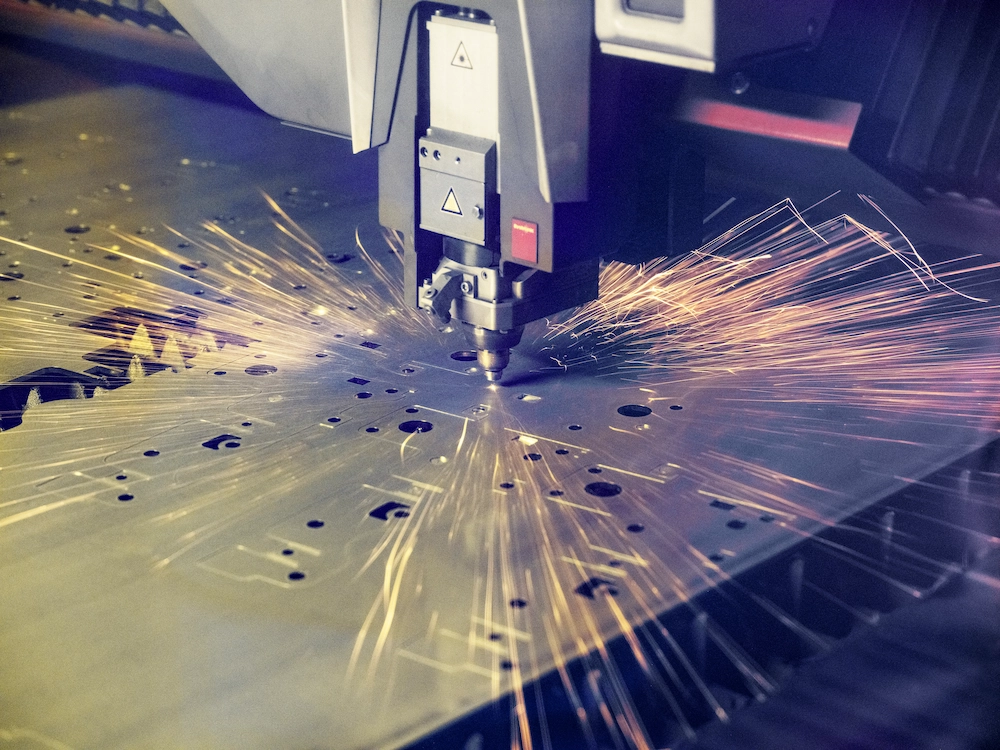
Laser cutting of thin sheet metal – what should you bear in mind?

Thin sheet metal is used in many applications where low weight, precision and a well-thought-out design are important. At the same time, the thin material thickness places specific demands on the manufacturing process. When laser-cutting thin sheet metal, factors such as heat input, cutting parameters and the geometry of the workpiece must be adjusted to ensure a consistent result and the required quality. 

When the right materials, machine settings and design work in harmony, it is possible to manufacture components with complex shapes, holes and cut-outs with a high degree of precision. However, even at the design stage, there are several factors worth taking into account. 

What does laser cutting of thin sheet metal involve? 

Laser cutting of thin sheet metal involves using a laser to cut details out of relatively thin sheet metal. The main difference between thinner sheet metal and thicker materials is that it reacts more quickly to the heat applied during cutting. This makes controlling the process particularly important. 

By laser cutting of sheet metal You can create both simple contours and features with more complex geometry. Holes, grooves, recesses and other cut-outs can be integrated directly into the feature, reducing the need for further machining. 

The technology is suitable for prototypes as well as small and medium-sized production runs. The most appropriate solution depends, amongst other things, on the material, thickness, the design of the component and the required tolerances. 

At Stans & Press, we offer laser cutting of materials including steel, stainless steel, aluminium, copper, brass, Magnellis, Aluzink, and hot-dip and electro-galvanised sheet metal. Our machinery comprises three laser cutting machines with power outputs ranging from 6.0 to 12.0 kW. 

What factors influence the results of laser cutting of thin sheet metal? 

Several factors come into play when cutting a thin sheet metal component: 

The material is of great importance. Different metals conduct and react to heat in different ways, and the properties of the surface can also affect the cutting process. For example, the conditions may differ between ordinary steel, stainless steel and aluminium. 

The thickness of the material affects which cutting parameters are suitable. The thinner the material, the more important it is that the process is adapted to avoid unnecessary heat build-up or deformation.

The cutting parameters also affect the result. Power, cutting speed, focus mode and the selected cutting gas must be tailored to the material’s properties and thickness. A well-optimised process contributes to a clean cut and stable production. 

Finally, the design of the component plays an important role. Small holes, very narrow grooves, closely spaced contours and small areas of remaining material can make a component more delicate during cutting. 


How does thin sheet metal affect precision and cut quality? 

As the material is thin, there is less material mass available to absorb and distribute the heat generated during cutting. Consequently, small variations in the process can have a greater impact on the finished component. 

The aim of laser cutting sheet metal is to achieve clean cut surfaces, correct dimensions and a component that retains its shape. To achieve this, careful control is required of factors such as machine settings, materials and the cutting process. 

Another important aspect is that thinner components may be more sensitive to movement and deformation. This means that the size and geometry of the component also need to be taken into account when planning production. 

With the right process conditions, laser cutting of steel and other sheet metal materials can achieve a high degree of precision, even when the parts feature small and complex contours.  

What types of parts are suitable for laser cutting of thin sheet metal? 

Laser cutting Sheet metal fabrication is particularly useful when a component has a geometry that would be time-consuming to produce using traditional methods. As the contour can be programmed digitally, there is great flexibility in the design. 

Examples of components where laser cutting may be suitable include: 

  • sheet metal components with complex outer contours 
  • parts with lots of holes or cut-outs 
  • cover plates and panels 
  • brackets and supports 
  • components with recesses and grooves 
  • prototypes and bespoke components 
  • parts that will later be riveted or welded together. 

For certain components, laser cutting may be the first step in a longer production chain. A cut sheet metal part may, for example, subsequently be press-brought, welded, surface-treated or assembled. 

What should be taken into account right from the design stage? 

A well-thought-out design creates better conditions for a high-quality laser-cut component. Adapt the geometry, holes and narrow slots to the material thickness, and specify clear tolerances for dimensions that are critical to the component’s function. 

Also bear in mind any subsequent processing. If the part is to be bent, the positioning of holes, slots and other features will need to be adjusted to ensure that the bending process works. 

At Stans & Press, we offer both laser cutting and press braking, which makes it possible to combine cutting and bending within the same production line. 

Laser cutting of thin sheet metal at Stans & Press 

At Stans & Press, we combine extensive experience in sheet metal working with a modern range of machinery. We have three laser cutting machines with power outputs ranging from 6.0 to 12.0 kW and can handle sheet metal formats up to 2,000 × 4,000 mm. Our laser machines, with power ratings of up to 8 kW, are particularly suitable for thinner materials, including stainless steel, brass and copper. 

We also have a 12 kW laser machine fitted with ByTrans Extended for more efficient operation. This machine is also suitable for thicker sheet metal. With a mixed-gas system, we can combine high cutting speeds with excellent cutting results. 

What’s more, we offer more than just laser cutting. By bringing together several stages of the manufacturing process under one roof, we can also assist with, for example, press braking, welding, machining, surface treatment, assembly and product packaging. 

If we are involved at an early stage in the project, we can also contribute our experience right from the design phase. Together, we can review materials, geometry, tolerances and subsequent machining to find a solution that works throughout the entire production process. 

Do you need laser-cut parts made from thin sheet metal? Contact us at Stans & Press and we’ll help you find the right solution based on your drawing, your material and your requirements!

Contact us